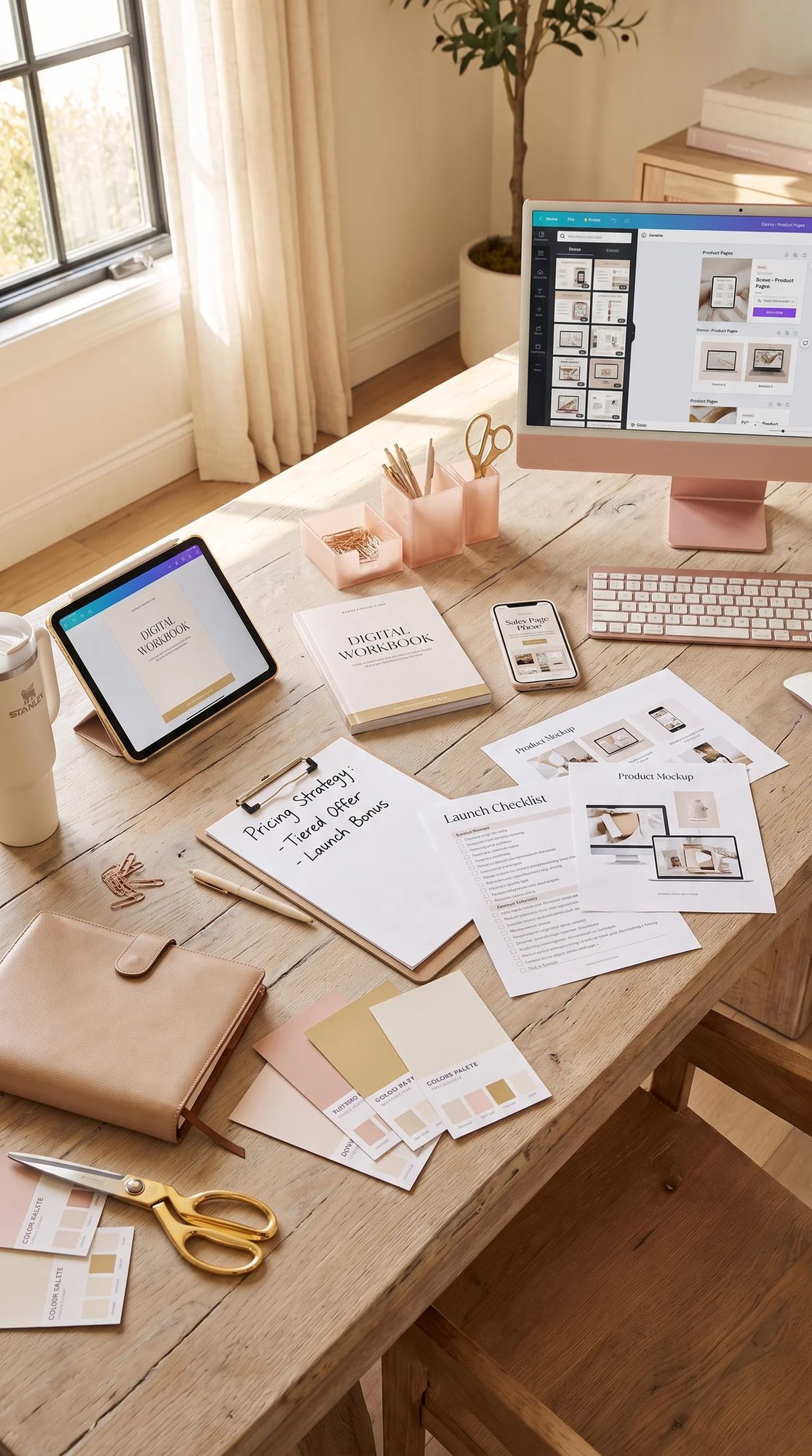
Ask a woman who has been circling a digital business for eight months what's holding her back and she will almost always say some version of the same thing: I don't really know how to sell. It sounds like the honest answer. It is almost never the true one. Because if you hand that same woman a finished product, a live shop, a month of scheduled content and a listing that already ranks, she does not freeze at the point of sale. She sells. The selling was never the wall. The wall was four steps back, and she has been standing at it so long she has stopped seeing it as a wall at all.
The wrong diagnosis costs you the year
"I need to learn to sell" is what a stalled business sounds like from the inside. It sends you to a sales course when what you needed was inventory.
This is the part that quietly eats twelve months. You diagnose a selling problem, so you go and learn selling. You read about hooks and objections and pricing psychology. You get genuinely better at all of it. And at the end you are still sitting in front of a blank Canva page with nothing to apply any of it to.
Nothing you learned was wrong. It just wasn't the constraint. Learning to sell when you have nothing to sell is like getting very good at driving and never buying a car.
Name the actual blocker out loud before you buy the solution to a different one. If you cannot finish the sentence "the thing I would sell today is ___," your problem is not sales.
The four gates, and why they feel like one
There are four separate jobs between you and your first sale. Most people are stuck at all four simultaneously, which is why it feels like one enormous impossible thing.
No product. Designing one from a blank page is the job that eats the month. Not because it is hard — because it is open-ended, and open-ended work is the kind that gets postponed indefinitely.
No shop. Etsy, Stan, Beacons. Forty-seven half-relevant tutorials, three abandoned account setups, still not live.
Nothing to post. The shop finally exists and opens onto an empty feed. Now it needs reels, Pins, carousels, stories — a second full-time job appearing at exactly the moment you thought you were finished.
Listings nobody clicks. Titles, tags, descriptions, mockups. This is where good products die quietly, and the death looks so much like "my product wasn't good enough" that most people conclude exactly that and stop.
Four gates. Solve one and you are still stuck. That is the entire reason this feels hopeless rather than merely slow.
Attacking the gates in order and running out of momentum at gate two. They are not sequential obstacles to be ground through. They are four things that need to arrive at once.
The blank page is the most expensive thing you own
A thirty-page guide is roughly three weeks of your evenings. A hundred-piece reel pack is a month. That is the real price of starting from nothing.
Nobody counts this cost properly because it is paid in scattered hours rather than in one visible number. But do the arithmetic honestly. Write the guide, design the guide, build the mockups, write the listing, then make the content to launch it. You are three months in and you have one product.
And a shop with one product in it does not read as a shop. It reads as an experiment. Which affects conversion, which affects your belief in the whole thing, which affects whether product two ever gets made.
The women who get past this are almost never the ones who worked hardest at designing. They are the ones who found a way to skip the blank page entirely and spend their hours on the parts that actually compound — the brand, the positioning, the traffic.
What PLR actually is, said plainly
Private label rights means you get a finished product and the legal right to put your name on it, sell it, and keep what you earn. It also means you are not the only person who downloaded the file.
I want to be direct about the second half of that sentence, because the people selling PLR badly tend to leave it out and then their customers feel misled six weeks later.
PLR is not exclusive. Other women will download the same source files you do. If what you want is a product that is unmistakably yours and nobody else's on earth, PLR is the wrong tool and you should build from scratch with my blessing.
But that is a much narrower objection than it first appears — because the source file is not what your customer buys. She buys a finished thing in your colours, under your name, positioned for the specific woman you understand and your competitor doesn't. Two people can start from the same template and end up with products that share nothing a buyer would ever notice.
The Pretty & Paid PLR Vault™ exists for exactly this. It hands you the product already finished, the training to open the shop, the content to market it, and a tool that writes your title, description, tags and mockups. All four gates, at once, which is the only way they get solved.
Nine vaults · 92 rebrandable products today · 20 brand-new ones every month · Faceless reels, Pins, carousels and stock imagery to launch them · Etsy, Stan, Beacons and Canva rebranding training · PLR Glow Studio for listings · Full resell licence that survives cancellation
It is $11 a month, billed on its own and never part of the membership. Look through what's in it →
The rebrand is the product
Nobody is paying for your fonts. They are paying because you understood their situation well enough to package something for it.
Here is where women new to this get the value backwards. They assume the design is the asset and the positioning is decoration. It is the other way round, and it always has been.
Take the same wellness planner. One woman lists it as "Daily Wellness Planner — Printable PDF." Another rebrands it for night-shift nurses, changes four spreads to match a shift rotation, prices it higher, and writes a listing that names the exact problem of eating properly on nights. Same source file. Not remotely the same product, and not the same money.
What the second woman did took an afternoon. What she skipped took three months. That is the entire trade, and once you see it clearly the objection about exclusivity mostly dissolves — because the thing that made her version work was never in the file.
Go deeper — How to Create Your First Offer in a Week →
What thirty days actually looks like
Not a promise about money. A description of what would be sitting on your own hard drive, which is a thing I can be specific about.
Week one. You pick a lane and open the files. Ninety-two products, nine vaults. Choose the three that fit your niche, swap the colours, fonts and logo, and they are finished and on your desktop by Sunday.
Week two. Your shop exists. The training walks you through Etsy, Stan or Beacons, and your first listings go up with real, finished products behind them instead of placeholders.
Week three. You stop scrambling for content. A month of faceless reels and templates queued, so posting takes twenty minutes on a Sunday rather than your whole week.
Week four. The next drop lands. Twenty brand-new products, a fresh theme. Your shelf refills before it ever looks empty.
By day thirty: a storefront with real products in it, a content bank deep enough to post from for months, ninety-two rebrandable products nobody can take back, and a library that restocks itself on the first of every month.
The licence survives cancellation. Join for one month, download every file, cancel the next morning — and all of it is still yours to edit, rebrand and sell permanently. You are paying for the doorway and the new work arriving each month, never renting what is already on your desktop.
The three things that stop people
Each objection is reasonable. Each one has a plain answer.
"It feels like cheating." Every shop you have ever bought from sells something it did not manufacture. Wholesale is not a moral category, it is how retail works. What you are adding is the brand, the audience understanding and the distribution — which is the part that was always doing the work.
"I can't design." You do not need to. Everything opens in Canva as an editable template and the rebranding training covers the workflow. If you can change a colour and type your name, you can finish a product.
"I'll build my own once I know what sells." You cannot know what sells until something is listed. This is the loop that keeps people at the starting line for a year — waiting for market data that only exists on the other side of publishing. Start with rebranded inventory, watch what moves, then build originals into the demand you have proven.
The gap between the women doing this and the women reading about doing this is almost never talent. It is that one group has something on the shelf and the other is still deciding what to make.
Look inside the Pretty & Paid PLR Vault™ — $11/month →
Frequently asked
What happens to my downloads if I cancel?
Nothing. They are yours permanently, licence included. Cancelling closes the door on new downloads — it never reaches back for what is already on your computer.
$9 and $11 — is this the upgraded membership?
No. Membership Standard is $9 a month and teaches you to build. The Pretty & Paid PLR Vault™ is $11 a month and hands you the stock. Two dollars apart by coincidence — neither one includes the other, and neither one comes first.
Is this part of the membership?
No, and it never has been. The Pretty & Paid PLR Vault™ is its own separate subscription — a different product doing a completely different job.
Do I need an audience first?
No. Products are what give you something to point traffic at, so building them first is the correct order rather than the impatient one.
Can I sell these on Etsy?
Yes. Full private label rights means you can rebrand, price and sell them wherever you like, keeping what you earn — and the Etsy, Stan and Beacons training inside covers opening the shop itself.